

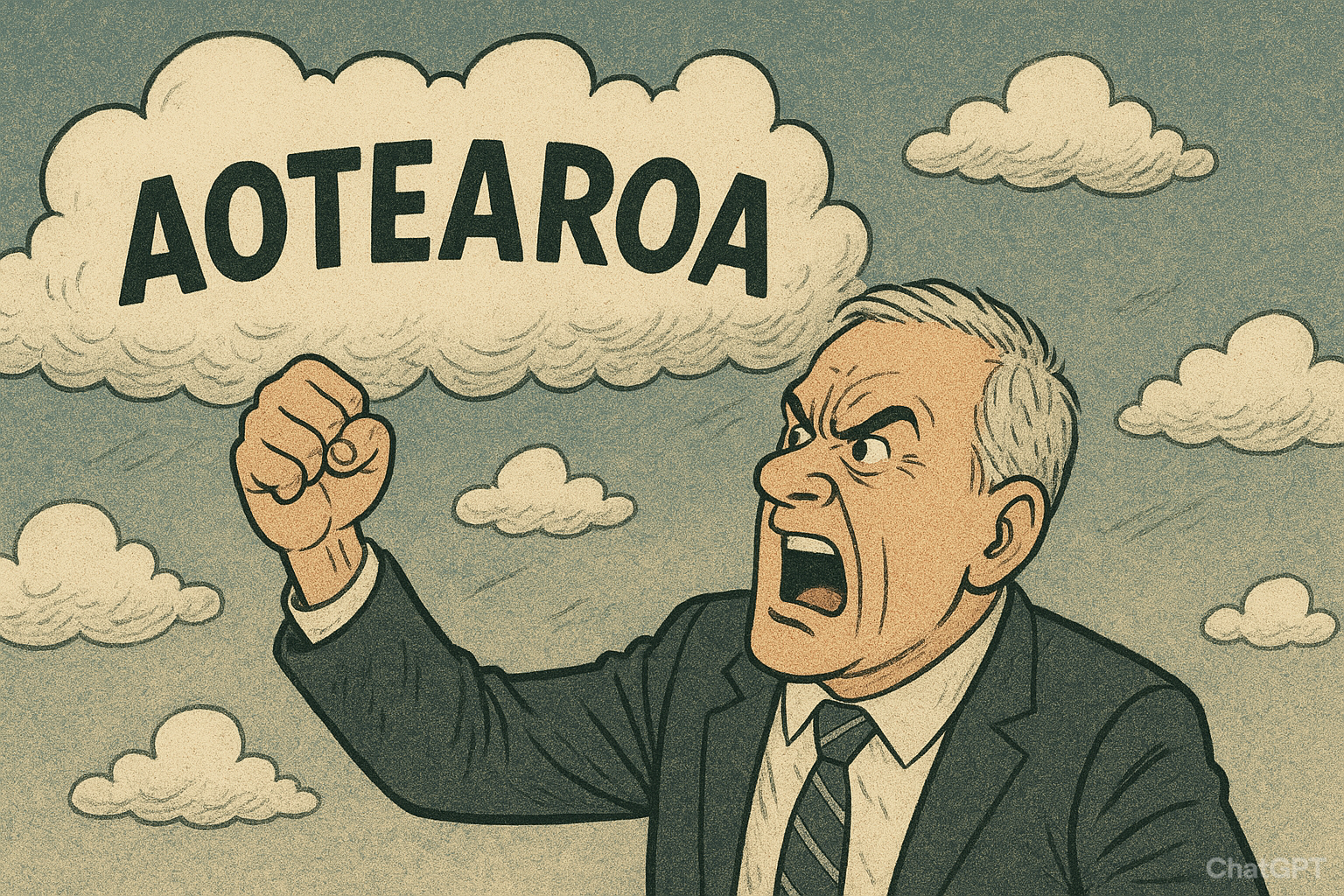
It was a simple question on whether or not candidates thought Greater Wellington Regional Council should open up its workshops and briefings as recommended by the Ombudsman. But for one ACT local government candidate, the fact that this publication is named Local Aotearoa meant he was unable to provide an answer:
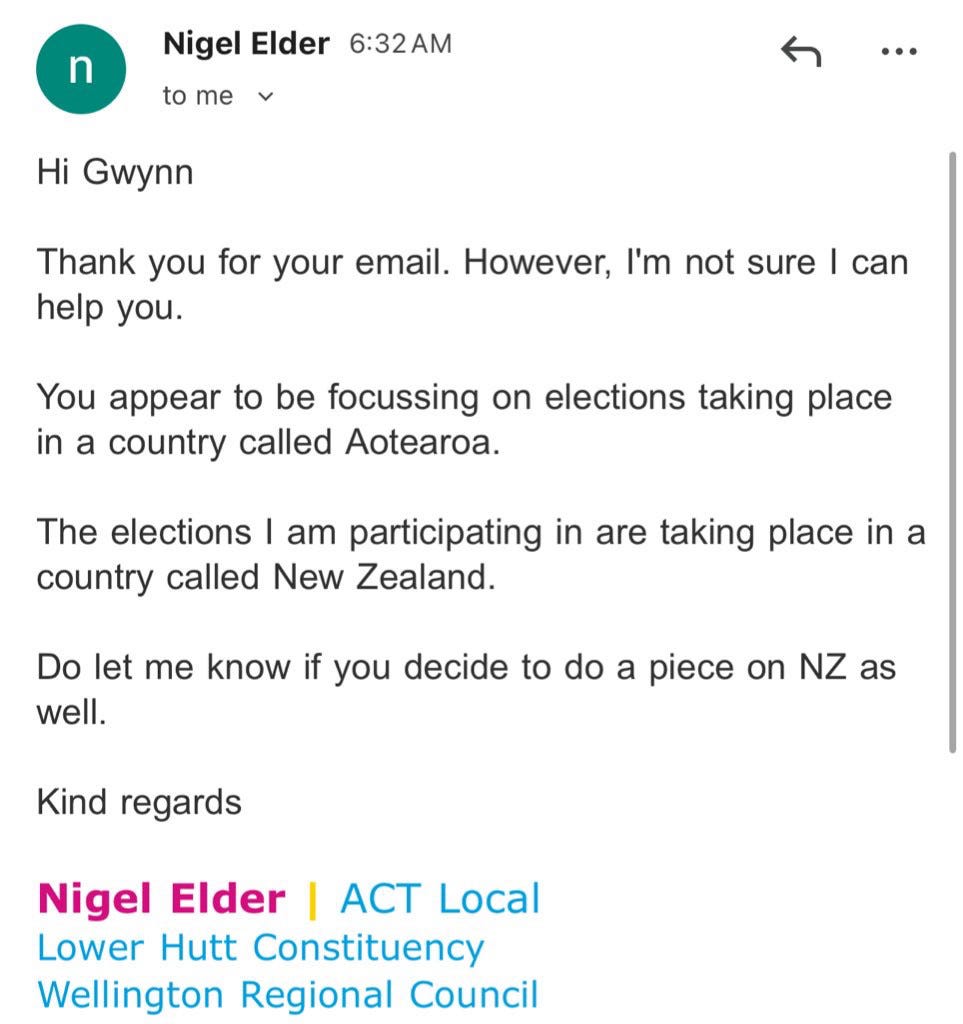
In turns out that I have some big news for ACT’s Nigel Elder…
You see, if Elder doesn’t think Aotearoa refers to New Zealand, then he’s in for an absolute treat when he realises that our passport uses Aotearoa as the te reo Māori name for New Zealand.
He must also have been very confused when he was serving with our defence force, given that in te reo Māori its name is Te Ope Kātua O Aotearoa. On a realted note, if he happens to be part of the RSA, then I ponder what happens when he learns that the RNZRSA has a te reo Māori name of Te Rātonga Kāhui Mōrehu a Tūmatauenga ō Aotearoa.
I certainly hope he never has to visit the main web portal of our government, which translates New Zealand Government in te reo Māori as Te Kāwanatanga o Aotearoa. This is also something which appears in the footer across numerous government services which, if he was being consistent with his stance on Local Aotearoa’s name, he can’t have ever possibly used such as the Companies Office or Inland Revenue.
Presumably he’s also never visited his ACT party leader David Seymour at our Parliament, which goes by Pāremata Aotearoa in te reo Māori.
One can only guess as to his reaction when our Governor-General referred to our country as Aotearoa in te reo Māori.
Speaking of ACT, we can only imagine how bewildered Elder would be if he sees the biography of ACT List MP Mark Cameron, who is described on ACT’s own website as being committed to “protecting the future of rural communities across Aotearoa.”
I can only assume that Elder would be all at sea when he hears our national anthem sung first in te reo Māori, seeing as it uses Aotearoa to refer to New Zealand.
According to the press release announcing Elder’s candidacy, it mentions he’s been involved in exporting wine. I can only wonder what customs service he’s been dealing with given our government’s one is Te Mana Ārai O Aotearoa - New Zealand Customs Service.
Similarly, our wine sector’s main industry body frequently uses Aotearoa, as does the country’s big Pinot Noir conference.
My thoughts are with Elder when he discovers that the use of Aotearoa to refer to our country goes right to the very top, with even King Charles III using it!
Of course, it’s possible that Elder is unaware of the Māori Language Act 1987 which made Māori one of our official languages. Practices such as translanguaging, or the realisation that English is full of loanwords from other languages, might also be completely new to him too. Who are we to say.
It could also be that Elder doesn’t realise that it’s entirely possible for countries and places to have different names in different languages, or even within the same language. For example, the place commonly known in English as Wales is known by the Welsh as Cymru. Likewise that the place many know as Scotland is known in Scottish Gaelic as Alba. There’s also how Albion is another term infrequently used in English to refer to either England or Britain.

All that being said, there might be some inkling of evidence that Elder knows that a place or entity, especially one with geographical boundaries, can have different names.
If you’re eagle-eyed, you might have noticed that Elder’s email signature in the above screenshot references “Wellington Regional Council”. This is the legal name of the local authority he’s standing as a candidate for as spelled out in the Local Government Act. Greater Wellington Regional Council, often referred to as Greater Wellington, is a trading/branding/promotional name for that same entity. It’s why if you look at the contracts that the regional council signs, they refer to Wellington Regional Council as the legal entity. There’s other similar situations in the local government world including the Canterbury Regional Council going by the name of Environment Canterbury, and my old haunt the Kapiti Coast District Council going by Kāpiti Coast District Council. We always had to triple check that when it came to things like contracts and the such that there was no macron above the a in Kapiti.
Coming back to Wellington Regional Council, it turns out that Elder was able to use the alternative promotional name of “Greater Wellington” to refer to the regional council when ACT’s local arm announced his candidacy. I did say before that this was just an inkling of evidence. Maybe using both Wellington Regional Council and Greater Wellington was just an innocent mistake on Elder’s part.
Ultimately, I’ll leave it to others to speculate as to what’s going on here.
In the meantime, I hope that everyone has been enjoying celebrating Te Wiki o Te Reo Māori and reflecting on how much further Aotearoa still has to go on its journey.
Update - 21 September 2025: Nigel Elder has sent another email this morning claiming his original email was a joke.