

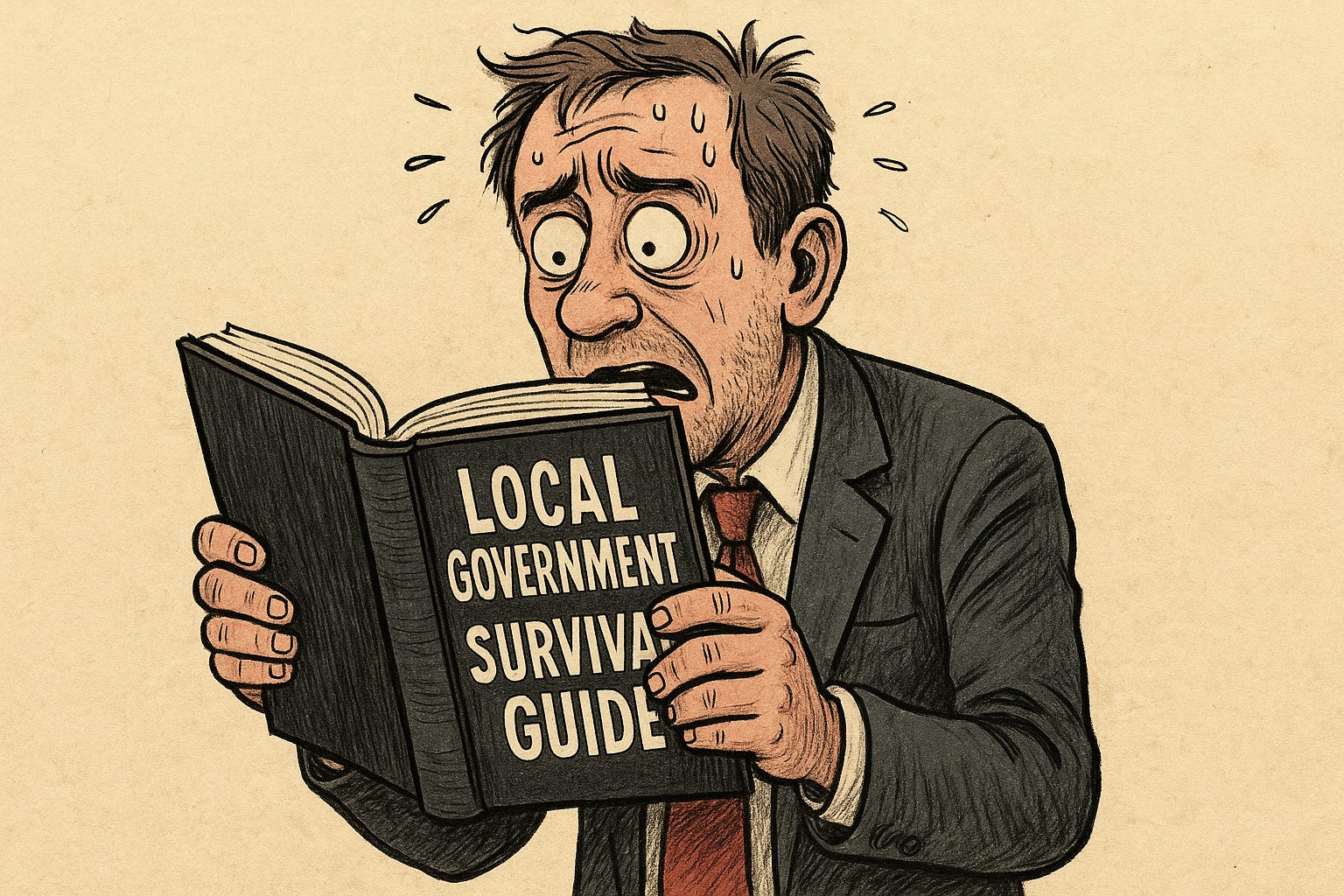
As the dust settles on this year’s local government elections, a new group of freshly elected and returning councillors are preparing themselves to tackle the coming triennium. As they grapple with the challenges ahead, I thought I’d share a few bits of advice from surviving my own triennium on Kāpiti Coast District Council.
Read your council papers
I can’t stress this first one enough, but you need to read your papers for meetings, workshops, and briefings! Most councils now issue tablets so you can read reports digitally, but don’t dismiss printed copies. Sometimes post-it notes on a physical page are still the best way to track questions.
Most importantly, as the old adage goes: prior preparation prevents piss-poor performance.
Ask questions early and often
Have a question about a report you’ve just read? Email the report’s author and authorising manager and ask as soon as possible. The more time you give them, the better the answer you’ll get back. Most councils should be allowing elected representatives to do this without needing to go through their Chief Executive or democratic services office. The better informed you can be heading into a meeting, the better the decision you’ll be able to make about the matter to hand.
Stay visible and keep your community informed
Nothing annoys me more than the councillor who gets elected, goes missing for most of the triennium, and then turns up three months out from the coming election seeking your vote once more. Seeing as community newspapers are dropping like flies these days, it’s up to you as an elected representative to take responsibility to keep your community informed about what’s happening at council.
It’s free to set up social media pages and post in your local community group about what’s going on. If you have the funds, you could splash out on your own webpage or even an email campaign platform. More importantly still, get out and about in your community. Turn up to community meetings about issues that are bubbling away, even if they don’t directly involve your council. You’re a leader in your community, act like it.
Officers’ advice is just that, advice
Quite often, you’ll find there’s pressure to defer to the advice or recommendations you’ll get from council officers in reports, especially if there’s a clock ticking to get something done. During my triennium, we had one councillor who would, nearly without fail, defer to the advice of council officers on nearly every decision regardless of what the community’s views or other expert advice and evidence was. I was tempted to make the joke, but didn’t, that maybe they should’ve just handed their seat over to the staff if they weren’t going to exercise their own judgement.
It’s worth pointing out that council officers are just trying to do their job, often under less than ideal circumstances in frequently shifting regulatory environments. They’re trying to give you their best advice to the best of their ability and should be doing so free of political considerations - that’s your job! Council officers aren’t infallible, but they’re also generally pretty good so be fair to them. However, you should seek out other viewpoints, other evidence, other experts, other examples from other councils and communities. Exercise your critical thinking skills, listen to your community, and hope for the best!
There’s a difference between governance and management, but it’s often blurred
The biggest gap between what communities think their elected representatives can do - and what they can actually do - comes down to the separation between governance and management.
On paper, councillors are there to set strategies, approve budgets, and through their oversight of the Chief Executive, hold the organisation accountable.
In practice, though, the line between governance and management is often blurry. While councillors shouldn’t try to micro-manage projects, you’d be surprised at how much influence you can have on behalf of your community, provided you know what you’re doing.
Basically while your job is meant to be about plans and policies, but for your community it’s really about potholes and parks. Forget that at your peril.
Build relationships early, especially with those you disagree with
Unless you’re Wayne Brown, who manages to offend everyone equally and still builds ad hoc alliances around different issues, you’d be surprised who you can build constructive working relationships with.
I probably surprised some of my colleagues who had me pinned as a right-wing politician because of my time working for John Key and Bill English, only to discover that the progressive platform I campaigned on was exactly what I worked to deliver, and it often aligned with what they wanted to achieve too.
I still keep in touch with several of them as we bounce ideas off each other, which just goes to show good relationships outlast one triennium.
Get to know your Chief Executive and understand their powers
A council Chief Executive is arguably the most influential person in the entire organisation, even more so than a council’s mayor or chair. They’re also the only person the governing body actually employs.
The relationship between CEO and the governing body is complex. If it’s good, then the council will perform well. If it isn’t, you’re in for choppy waters. It’s a relationship that cuts both ways too, with Chief Executives and elected representatives being equally responsible for making it work.
Understand their powers, respect their role, but don’t be afraid to hold them to account. That’s your job.
Understand the plan(s)
Everything in local government eventually comes back to the Long-Term Plan and the Annual Plans that flow from it. These are the organisation’s financial roadmaps. Understanding them will make a world of difference.
Learn how to read a balance sheet, how rating systems work, how debt is used, and how to tell a sound business case from a dodgy one. Develop a nose for appropriate risk management, and be wary of the sunk-cost fallacy that so often railroads councils into throwing good money after bad.
Councillors who understand the numbers make better decisions and are far less likely to be bamboozled.
Get to know your Standing Orders
As a self-confessed “process bro”, knowing your way around your council’s Standing Orders is a secret super power. Being able to make amendments to motions, correctly submitting a notice of motion, or tripping up someone on the other side of a debate due to a technicality is way more powerful than you can imagine. It’s more than likely that your own mayor or chair, or even your CEO, doesn’t quite know Standing Orders as well as they should, and if you have a working knowledge, it’ll be hugely beneficial to you.
Have an open mind, not an empty one
Speaking of which, the spectre of conflicts of interest and pre-determination will be hung over your head like a sword of Damocles at times. You’ll be warned constantly about the risk of having been seen to pre-determined yourself on matters coming up before council, or having conflicts of interest for the smallest connection to someone in the community.
In my experience, councils aren’t very good at understanding either of these things, let alone advising elected representatives on them or enforcing those standards themselves.
Let me give you an example of how messy this can get: I remember a matter before our council where the council had appointed a company director/advisor as an “independent chair” of an advisory board. The company in question had told council that the matter would benefit them, and - unsurprisingly - the advisory board (headed up by a director of that company) endorsed the proposal.
Not only weren’t councillors told about the glaring conflict of interest, but trying to get some accountability over it proved to be impossible. After my triennium I eventually got an acknowledgement that the council had gotten things wrong and would look to improve its processes, but by then it was thankfully immaterial as the proposal had - again unsurprisingly - collapsed.
Just to add to things, a councillor who was part of another advisory board voted with that advisory board to endorse the project (essentially meaning they had pre-determined their vote at the council table and should have recused themselves), while another proudly announced on Facebook the night before that they were going to vote for it - despite there being several hours of public speaking on the matter at the council meeting the next day.
None of this is to say that councillors can’t have views on matters coming before council, but they need to be open to having their minds changed, and in some of these cases you really had to question whether that was going to be the case.
The rule of thumb to work to is a snippet of advice from a previous Auditor-General: have an open mind, not an empty one.
Be prepared to stand up and stand out
Being elected by your community to represent them is an incredible privilege and opportunity. You get a platform to make a difference that most people will never get. Use it! Whether it’s to speak up about issues in your community, or get involved in bigger national challenges, do it. Despite being a first-term councillor from a mid-sized council, I managed to be a lead voice in the discussion nationally and regionally on issues like local government reform, local government transparency and accountability, and expanding commuter rail services.
Balancing principles and pragmatism
One of the biggest challenges I found was weighing up what my principles told me was right, and what the views of my community were - generally indicated through either feedback I’d collected or through council’s formal and informal community engagement tools. You need to figure out where that balance is for you. I think for mayors and chairs, they need to be principled and pragmatic in equal measure in order to try and foster teamwork across their council table.
For councillors however, you get a bit more freedom on where that balance sits. There are going to be times to dig your heels in, and times to give ground to find a way forward. How each councillor makes that work is up to them individually. Ultimately, one of the reasons I didn’t stand again was not being willing to make promises that I didn’t believe were right - but would have been popular with a large number of people who actually vote - in order to win.
Every councillor has their own community mandate
I disagreed with our Mayor K Gurunathan during my triennium on many things, passionately so at times, but one thing he said at a mayoral debate has stuck with me. It was that everyone at the council table has a mandate from their community to be there to represent them. You mightn’t agree with their politics, but they have been voted to be there by members of your community, and it’s important to acknowledge that. You don’t necessarily have to respect them or their views, but recognising that they have the same right to be there as you do is worth keeping in mind at times.
Don’t forget you’re there to represent your community
A lot of elected representatives fall into the trap of forgetting that the main reason they’re sitting at the council table is to represent their community on council. Instead, they end up only representing council to the community, which never ends well. For example, if your CEO degrades a member of after they’ve presented to council, rushing to community forums to tell people to stop complaining isn’t going to go down well. It’s also probably not a good look to label people as “political enemies” for the “crime” of using LGOIMA to correctly request information on council expenditure. Don’t get me wrong, you definitely have a role in sharing council’s work with the community, but there’s a fine line between ensuring people are informed and suffering from organisational capture.
Similarly, don’t be fooled by those who will tell you there’s collective responsibility for council decisions like there is for Cabinet decisions in central government. There’s not. You’re absolutely free to disagree with a decision that your council has voted in favour of. Remember to caveat it as your personal view and not that of the governing body and to try to be as respectful as you can be given the circumstances.
Reply to all is both your best friend, and worst enemy
If you’ve come from the corporate world, you’ll be familiar with the fun of reply to all emails. Well be prepared for them to take on a whole new level of intensity when you’re on council. This is both a curse and a blessing. For example, it can be a great way of shining a spotlight on an elected representative who’s been condescending to you in a direct email by replying to all your colleagues to call it out - this method works surprisingly well when the sender realises that you’re just going to share their comments with all their colleagues. Conversely, it can end up being a blackhole of endless performative nonsense, which I’ll confess I occasionally got caught up in myself.
Also, remember that a lot of this correspondence can be released under the Local Government Official Information and Meetings Act.
Try to switch off occasionally
One thing I can say is that politics, even (or maybe especially?) local politics, can be all consuming. If you’re doing a good job you’ll be recognised and stopped by people in your community who want to talk to you about various issues. You’ll be invited to events and to speak throughout your community. You’ll get tons of correspondence: some of it great, some of it robust, and some of it brutal. You’ll wake up in the middle of the night dreading the council meeting the next day, questioning a vote you made, or replaying what you said in a debate. It can and will burn you out.
I remember my first panic attack right before an online council meeting during the pandemic. My heart raced, I could barely breathe, I felt sick in my stomach, I struggled to string a thought together. It felt like I was back in the dark days of when I was in the middle of a thyroid crisis before I was diagnosed with Grave’s Disease. I wanted to throw it all in then and there. It was shortly after this that I rediscovered my love of running as a way to not only release all the stress by tuning out for an hour or more, but also to compartmentalise my political life from my personal one.
And remember…
Serving your community is one of the most demanding and rewarding things you’ll ever do. If you approach it with curiosity, courage, and compassion, you’ll leave your council and your community better than you found it.
There’s probably a lot more advice that I haven’t thought of and will remember in a cold sweat at 3am, but I can always write another one of these further down the track. Likewise, once I’ve had a bit more time to digest the elections and consider what all the results mean, as I’m reluctant to jump to conclusions until I’ve seen some more data and pondered things a little more, I’ll share my thoughts here.
In the meantime, if you’ve been elected - good luck. You’re going to need it!
Oh and before I forget: Subscribe to Local Aotearoa
No, seriously, please do.